
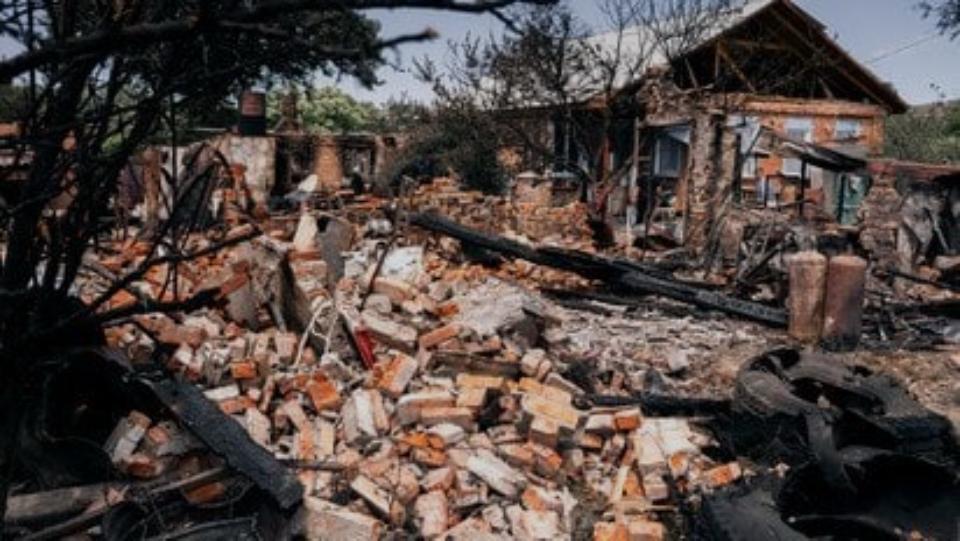
In mid-December, Russian military personnel who crossed the Ukrainian border abducted residents of the village of Grabovskoye, located in close proximity to the border with Russia, and forcibly took them to Russian territory.
According to Ukrainian authorities and human rights activists, about 50 civilians were captured by Russian military personnel and held for several days without contact with the outside world, without access to medical care or basic living conditions.
After two days, the people were forcibly taken out of Ukraine to Russian territory. Their exact whereabouts are still unknown, which poses serious risks to the lives and health of those abducted.
These are residents of a border town who, for various reasons, did not leave their homes after the full-scale invasion. As Ukrainian officials note, it is precisely such villages and their residents that often become victims of war crimes committed by the Russian military.
From the point of view of international law, what happened leaves no room for interpretation. The unlawful deprivation of liberty and forcible displacement of civilians are prohibited by the Geneva Convention and qualify as serious violations of the laws and customs of war.
Human rights organizations, including Ukrainian and international NGOs, emphasize that the deportation of civilians is not a random incident, but a recurring pattern that has previously been recorded in the Kherson, Zaporizhzhia, and Luhansk regions. In a number of cases, there were reports of subsequent pressure, detention in filtration camps, torture, and forced acquisition of Russian documents.
Ukrainian defense forces are currently conducting stabilization measures on this section of the front in the Sumy region. Their goal is to identify sabotage groups, restore control, and prevent new abductions.
Official Kyiv has already appealed to its international partners to increase pressure on Moscow to return illegally detained citizens. The Ukrainian Foreign Ministry emphasizes that without a clear and tough response, such crimes will continue, as the occupying forces do not face immediate consequences for their actions.
The tragedy in Grabovskyi once again raises the painful question of the fate of civilians remaining in the zone of active hostilities. The Ukrainian authorities state outright that in wartime, proximity to the front line or border turns populated areas into zones of mortal danger.
Evacuation, however difficult it may be, remains the only real way to protect oneself and one’s family. The practice of recent months shows that for the occupiers, civilian status is no guarantee of safety.
The story of the village in Sumy region is not an exception, but a tragic routine of the war unleashed by the Kremlin, in which kidnapping becomes a tool of intimidation and blackmail. And the longer the international community limits itself to expressing «deep concern,» the more such cases remain unpunished.